

What if the credit score you’re worried about isn’t the only thing shaping your car loan options? If you’ve searched “what credit score do I need to buy a car,” conflicting answers can make it feel as if one number decides everything. There’s no single score that guarantees approval or automatically rules you out. Experian classifies scores of 661 and higher as prime, but lenders set their own requirements.
It’s understandable to want a clear cutoff before you apply. Your score can affect the loan options and interest rate you’re offered, but lenders may also consider your income, existing debts, down payment, requested loan amount, and the vehicle you want to buy. A lower score doesn’t tell the whole story, and approval is never guaranteed.
This 2026 guide explains how credit scores can shape used-car financing, what else lenders may consider, and how to prepare before applying. You’ll also find practical steps if your credit needs work. In Chandler, Any Credit Auto Sales LLC helps shoppers explore applications with third-party lenders and provides credit guidance for people with different credit histories.
Key Takeaways
- There’s no universal score that guarantees a car loan. Lender requirements and your full application both matter when asking, “what credit score do I need to buy a car?”
- Credit scores help lenders assess repayment risk, but lenders may use different scoring models and review other credit information.
- Income, current debts, your down payment, requested loan amount, loan term, and vehicle details can all shape a financing application.
- Prepare by reviewing your credit information, setting a budget, and gathering the details you may need before exploring options.
- Shoppers in Chandler can explore used vehicles and applications connected with third-party lenders, with no assumption that approval is guaranteed.
What credit score do you need to buy a car? The short answer
There isn’t one credit score that guarantees access to every car loan. Each lender sets its own criteria, and different lending partners may review the same application differently. So if you’re asking, “what credit score do I need to buy a car,” the most accurate answer is that a score alone can’t tell you whether you’ll be approved.
No universal minimum credit score applies to every car loan because each lender assesses risk using its own standards and the details of your full application.
It helps to separate three things: whether a lender approves the application, what loan terms it offers, and how much borrowing may cost over time. Approval doesn’t automatically mean the terms fit your budget. A score that raises questions doesn’t determine the final decision either. The lender reviews the application and makes that decision.
Why there is no universal minimum credit score
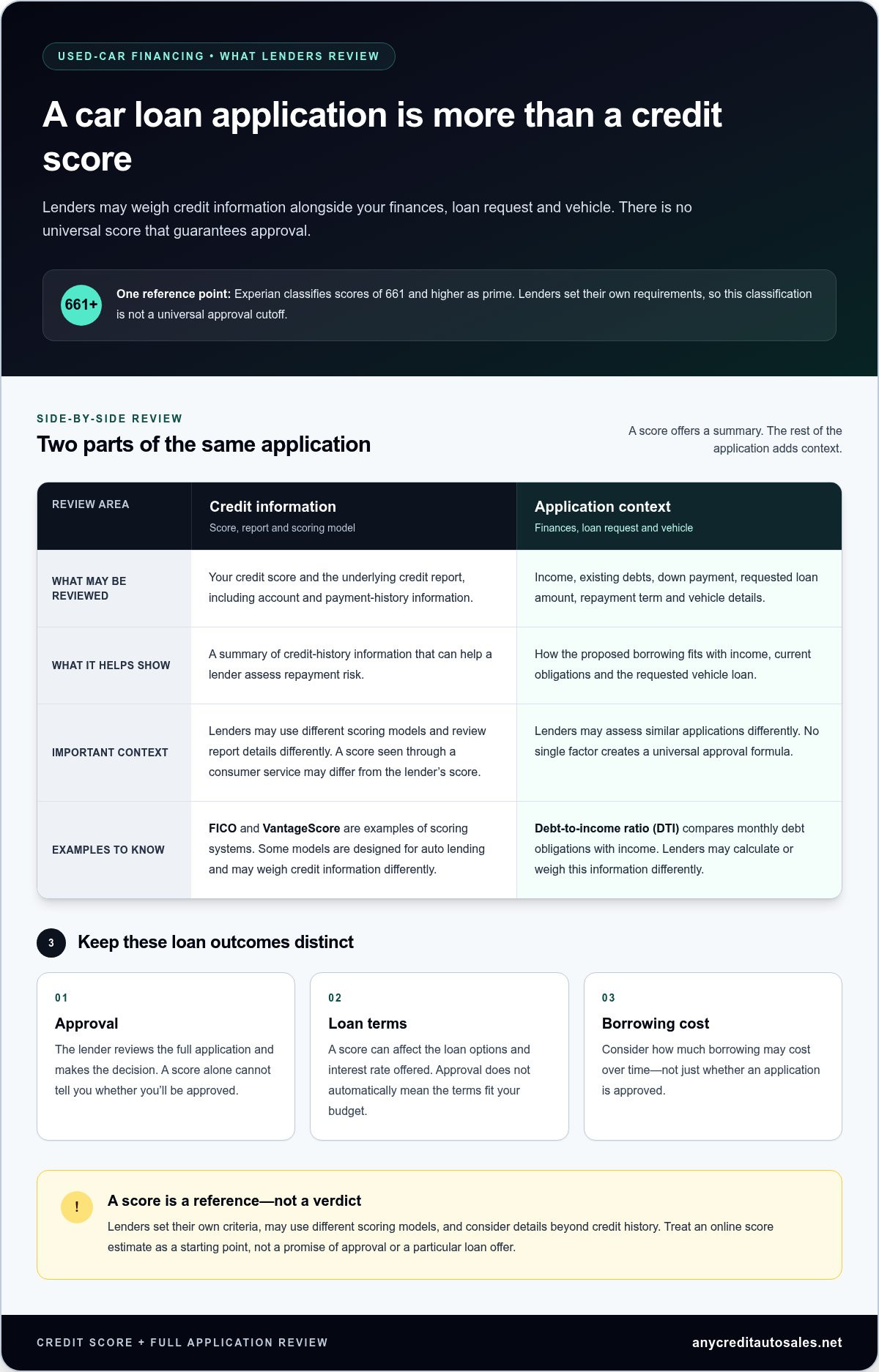
Lenders can use different approval standards and ways to assess risk. They may consider information beyond your score, including your income, existing debts, requested loan amount, and the vehicle you want to buy. Your score is one part of the picture, not a promise of approval or a complete measure of your ability to manage a particular loan.
This is why broad claims about one “required” score can be misleading. A cutoff used by one lender may not apply to another. Treat an online estimate as a starting point for understanding your credit profile, rather than as a final answer about approval.
What a credit score can tell a lender
A credit score is a number based on information in your credit history. That history can include details about accounts and how you’ve handled past borrowing. In plain terms, the score gives a lender one way to summarize credit information when considering an application. It can’t guarantee what happens next.
Lenders may use different scoring models, which are methods for turning credit information into a score. They may also review your credit report, the record of your credit accounts and activity. As a result, a score you see through a consumer service may differ from the score a lender uses. Even a close match is an estimate, not a lender’s decision.
Use your score to help prepare, not to rule yourself in or out. The next step is to understand what else lenders may consider alongside it.
How lenders use credit scores when reviewing a car loan
A credit score helps a lender estimate how you’ve managed credit in the past. It can inform a review of repayment risk, but it doesn’t predict exactly what a lender will decide. If you’re still wondering “what credit score do I need to buy a car,” remember that lenders may assess similar scores differently based on the rest of an application.
A credit score is one input in a lender’s review, not the loan decision itself. The Consumer Financial Protection Bureau’s Consumer Financial Protection Bureau on Auto Loans offers guidance on understanding auto financing and preparing to borrow.
Credit scores, credit reports, and auto-loan scoring
A credit score is a number calculated from information about your credit history. A credit report is the underlying record, which can include accounts and payment history. The score offers a quick summary; the report provides details that may put that summary in context.
FICO and VantageScore are examples of credit-scoring systems, not requirements every lender follows. Some scoring models are designed for auto lending and may weigh credit information differently. Lenders choose which information and models to use, so a score you see elsewhere may not match the score used to review your application.
Why the same score can lead to different outcomes
Lenders can set different review criteria, use different scoring models, and consider credit-report details in different ways. Two lenders might therefore reach different decisions on similar applications. Neither a general-purpose score nor an auto-focused score guarantees approval or a particular loan offer.
The loan request matters, too. The amount you want to borrow and the repayment term you request can affect how the lender views the application. A longer term spreads payments across more time, while the amount borrowed affects how much you’re asking the lender to finance. Lenders consider these details alongside your credit information, not in isolation.
Before applying, treat any score you’ve checked as a useful point of reference, not a promise or a verdict. If you’re exploring a used vehicle in Chandler, you can explore used-car options and submit a financing application connected with third-party lenders.
What matters beyond your credit score when financing a car?
Your credit score is only one part of a car-loan application. Lenders may also consider whether your income can support the proposed payment, what debts you already manage, how much you plan to borrow, and details about the vehicle. These factors help put your credit history in context, but they don’t create a universal approval formula.
Income, monthly debts, and the amount you want to borrow
A lender may review income to understand the money coming in and existing debts to see how much is already committed to monthly payments. Debt-to-income ratio, often shortened to DTI, compares monthly debt obligations with income. Lenders may calculate or weigh this information differently, so there isn’t one DTI figure that guarantees approval.
Consider the planned car payment alongside your other regular expenses. A payment that fits comfortably into your household budget may be easier to manage than one that leaves little room for essentials or unexpected costs. A realistic vehicle budget can also help you avoid applying to borrow more than you need. This is a planning tool, not a prediction of a lender’s decision.
Down payment, vehicle choice, and loan terms
The amount you request and the vehicle you choose can shape an application. A down payment reduces the amount you’re asking to borrow, but it doesn’t guarantee approval. Lenders may also consider vehicle details, such as its age, as part of their review.
Loan length matters, too. A longer repayment term can make each scheduled payment lower, but it may increase the total borrowing cost over time. Compare the payment and full repayment period, not just whether the monthly amount looks manageable.
| Application factor | What it may help a lender assess |
|---|---|
| Income | Your ability to manage a proposed payment |
| Existing monthly debts | How much of your income is already committed |
| Down payment | How much you need to borrow |
| Requested amount and loan term | The size and structure of the loan |
| Vehicle details | The vehicle tied to the loan request |
So, if you’re asking “what credit score do I need to buy a car,” look beyond the number. Review your overall budget and application details, too. Knowing what you can comfortably afford can help you explore used-car financing options with realistic expectations.
Preparing for a Car Loan at Any Credit Level
A little preparation can make the application process feel more manageable, whatever your credit history looks like. Start by reviewing your credit information, setting a comfortable budget, and gathering accurate details. Then explore financing options. These steps won’t guarantee approval or a better score, but they can help you understand your starting point and make informed choices.
Before applying: review your credit and monthly budget
Start by checking your credit reports through AnnualCreditReport.com, the federally authorized source for reports. Review account names, balances, payment history, and personal details. If you spot information you believe is wrong, follow the dispute process with the credit bureau that issued the report. Keep copies of documents that support your dispute.
Next, sketch out a vehicle budget. Consider what monthly payment feels manageable alongside insurance, fuel, existing bills, and regular household expenses. A car’s costs extend beyond the loan payment, so leave room for other expenses that come with driving. This is a personal planning step, not a lender’s approval formula.
Loan applications may lead to hard inquiries, which are checks of your credit report connected to a request for credit. Some scoring models may treat several auto-loan inquiries made while rate-shopping within a set period as one inquiry. The treatment and time window can vary by scoring model, so don’t assume every inquiry will be grouped the same way. Review current guidance for the scoring model involved, and focus on making financing comparisons within a reasonable shopping period.
When you are ready to explore financing
Gather the information an application may request. This can include details about your income, housing, employment, and the vehicle you’re considering. Use accurate, up-to-date information. Having it ready can make it easier to complete an application and understand what you’re being asked.
If prequalification is offered, treat it as an early indication, not a final loan approval. A lender may still need to review a full application and verify details before making a decision. Keep that distinction in mind as you compare options.
Look at the full repayment obligation, not only the monthly payment. Consider the loan term and total amount you would repay, and decide whether the commitment fits your budget. If you’re asking “what credit score do I need to buy a car,” preparation can help you explore the question with clearer expectations, but only a lender can decide on an application.
Any Credit Auto Sales LLC in Chandler helps shoppers explore used vehicles and financing applications with third-party lenders, and provides credit guidance for different credit histories.
Explore used-car financing options with support in Chandler
Understanding how lenders review an application is a useful first step. From there, look at used vehicles that fit your needs and explore financing with realistic expectations. Any Credit Auto Sales LLC is a used-car dealership in Chandler serving shoppers from nearby communities, including Mesa, Tempe, Phoenix, Queen Creek, and San Tan. The dealership helps shoppers navigate applications to outside lending partners, while the lender makes the decision based on the application. No credit score or dealership conversation can guarantee approval.
What local shoppers can expect from the financing process
Any Credit Auto Sales LLC provides support as you consider vehicle choices and a financing application. The dealership works with third-party lenders and offers credit guidance for people with different credit histories. That can help you understand the steps involved and prepare to share accurate application information. The lender reviews the application and decides whether to approve it and what terms to offer.
A simple next step toward your next car
Start by thinking about the kind of vehicle that suits your everyday needs. Browse available used cars, trucks, and SUVs, then gather current details about your income, housing, and employment before exploring financing options. Accurate information can make it easier to complete an application and understand the choices presented. Take your time and keep your budget in view.
If you’re still asking, “what credit score do I need to buy a car,” remember that a score is only one part of the lender’s review. A particular number doesn’t settle the question. Browse used-car inventory or start a financing application with Any Credit Auto Sales LLC when you’re ready to take the next step.
Take Your Next Car-Buying Step with Confidence
If you’ve been asking, “what credit score do I need to buy a car,” remember that there isn’t one score that guarantees a loan. Lenders may consider your credit history alongside income, existing debts, down payment, loan amount, and vehicle details. Reviewing your credit information and setting a comfortable budget can help you explore options with a clearer picture of what works for you.
Your score matters, but it’s only one part of an application. Any Credit Auto Sales is a Chandler used-car dealership serving shoppers from nearby communities, including Mesa, Tempe, Phoenix, Queen Creek, and San Tan. The dealership helps shoppers explore applications with third-party lending partners and offers credit guidance for people with varied credit histories. Each lender makes its own decision, so approval and terms aren’t guaranteed.
When you’re ready, explore pre-owned vehicles and financing options at your own pace. A thoughtful next step can make the road ahead feel more manageable.
Frequently Asked Questions
What credit score do I need to buy a car?
There’s no single credit score that guarantees approval for every car loan. If you’re asking “what credit score do I need to buy a car,” the answer depends on the lender and your full application. Lenders may use different scoring models and weigh details like income, debts, down payment, loan amount, and vehicle. A score can help you understand your credit standing, but it can’t promise approval or specific loan terms.
Can I buy a car with a low credit score?
A low credit score doesn’t automatically rule out financing, but it can affect the options a lender considers. Lenders set their own criteria and may review your income, existing debts, down payment, and vehicle alongside your credit information. Any Credit Auto Sales in Chandler helps shoppers with different credit histories explore applications through third-party lenders. Each lender makes its own decision, so approval and terms aren’t guaranteed.
Do car lenders use a different credit score?
Some lenders may use a score designed for auto lending, while others may use a general credit score or another model. FICO and VantageScore are examples of scoring systems, not lender requirements. A score you see through a consumer service may differ from the one used in a loan review. Lenders may also consider details in your credit report, so one number doesn’t show everything they may assess.
Can I get a car loan with no credit history?
It may be possible, but having little or no credit history can make it harder for a lender to assess how you’ve managed borrowing. No credit history isn’t the same as a record of missed payments. Lenders may review other parts of your application, such as income, current obligations, down payment, and the vehicle you want. Their requirements differ, and only a lender can decide whether to approve your application.
Does a down payment help you get approved for a car loan?
A down payment can reduce the amount you need to borrow, which may be one factor in a lender’s review. It doesn’t guarantee approval or particular loan terms. Consider what you can put down while keeping enough money for regular expenses and unexpected needs. The lender will still assess your full application, including credit information, income, debts, requested amount, and vehicle details.
Will applying for a car loan hurt my credit score?
A lender’s review may involve a hard inquiry, which can affect your credit score. The effect and how multiple auto-loan inquiries are counted can depend on the scoring model and timing. Some models group inquiries made while rate-shopping within a set period, but the time window and treatment vary. Before applying, check current guidance for the scoring model involved, and don’t assume every inquiry will be grouped together.
What do lenders look at besides my credit score?
Lenders may consider income, employment details, monthly debts, down payment, requested loan amount, repayment term, and vehicle information. Debt-to-income ratio compares monthly debt obligations with income, though lenders may assess it differently. For shoppers in Chandler, Mesa, Tempe, Phoenix, Queen Creek, and San Tan, Any Credit Auto Sales helps navigate applications to third-party lending partners and offers credit guidance for varied credit histories. Lenders make the final decisions.


