
Bad credit doesn’t automatically rule out a car loan in Chandler. Auto financing with bad credit in Chandler depends on your budget, the vehicle you choose, and how a lender reviews your application. A used car, truck, or SUV that fits your monthly budget can be a practical place to start.
It’s understandable to feel unsure about what you may qualify for or how to keep payments manageable. Start by deciding how much you can comfortably spend on a vehicle, then account for regular expenses and the transportation you need.
This guide explains what lenders may consider, how to set a realistic vehicle budget, and what to expect from the financing application process. You’ll also learn how to compare used cars, trucks, and SUVs based on your everyday needs.
Key Takeaways
- Past bankruptcy, foreclosure, or repossession doesn’t tell the whole story. Gather details about your current finances before exploring loan options.
- Build your vehicle budget around what you can manage after regular bills, not just the payment amount.
- Review how your debts and income fit together to understand what may affect an application and a comfortable monthly budget.
- Compare used cars, trucks, and SUVs by how well they fit your transportation needs and budget, then consider financing application and credit help.
Financing after bankruptcy, foreclosure, or repossession
Bankruptcy, foreclosure, or repossession can affect a loan application, but lenders also consider your current finances. Before applying, review your income, existing debts, and vehicle budget.
Financing After Credit Setbacks
After bankruptcy, foreclosure, or repossession, be ready to explain your current financial picture. A lender may weigh income, outstanding debt, payment history, and the amount requested alongside credit history. Auto lenders do not all use the same credit-score cutoff, so a score alone cannot tell you whether you may qualify. Before signing, compare the proposed payment and total amount owed.
Buy-here-pay-here dealerships arrange financing through the dealership, while banks and credit unions review applications as lenders. Compare written terms and payment structures, not just approval decisions. Arizona buyers should read the sale and loan documents carefully, keep copies, and understand the terms before signing. Applicable consumer protections depend on the transaction and its documents.
Down Payments, Cosigners, and Trade-Ins
There is no single down payment for every bad-credit application. The amount can depend on the vehicle, requested loan, lender’s decision, and your finances. Ask how the down payment affects the amount financed and planned payments. A cosigner may support an application, but also takes on responsibility under the agreement. Make sure both applicants understand that commitment before proceeding.
A trade-in may change how much you need to finance. Ask how its value and any remaining loan balance appear in the proposed figures. Review the contract for the amount financed, interest rate, payment schedule, fees, and total repayment. Subprime loans can have costly terms. Take time to read every page and compare the full cost, not just the monthly payment.
Application Requirements and Credit Criteria
Prepare identification, proof of income, residence details, and information about current debts. A lender may request additional documents to assess your application. A Chandler dealership that submits applications to lenders can help you explore financing. Compare the written terms carefully. Any Credit Auto Sales offers an auto financing application and credit help to guide you through possible next steps.
If you plan to use a cosigner or trade-in, include those details in your application and review how they affect the terms. If your payments later become more manageable or your credit improves, refinancing means applying for a new loan to replace the current one. Before deciding, compare the new loan’s total cost and terms with your existing agreement.
Approval based on current finances and ability to pay
Lenders consider more than a credit score when reviewing an auto loan application. They may assess income, existing debt, payment history, requested loan amount, and the vehicle. Your recent record of managing regular bills can help explain your current finances, especially after past credit setbacks. List reliable income and recurring expenses, then work out what remains for transportation.
There isn’t one current auto loan interest rate or APR for every borrower with bad credit in Arizona. The rate offered depends on the lender’s review, your credit profile, income, loan amount, vehicle, and repayment term. Compare APRs and total repayment amounts, not just monthly payments. A longer term may lower each payment while increasing the total interest paid.
Build a clear picture of your finances before applying. Gather proof of income and list monthly obligations, then choose a vehicle that fits what you can reasonably repay. For example, if your budget already includes rent, utilities, and existing loan payments, account for those first. Don’t treat an approved amount as a spending target. Choose a payment that leaves room for regular transportation costs and other bills.
Review an offer line by line before signing. Check the APR, amount financed, repayment schedule, total of payments, and any fees listed in the contract. Ask how a down payment or trade-in changes the amount borrowed. If you have more than one written offer, compare them using the same vehicle price and loan term to make differences easier to spot.
Credit help can clarify how your credit history fits into an application and which financial details to organize. Bring accurate information about income and debts, and focus on terms that fit your budget rather than rushing into a decision.
Debt-to-income ratio and monthly budget review
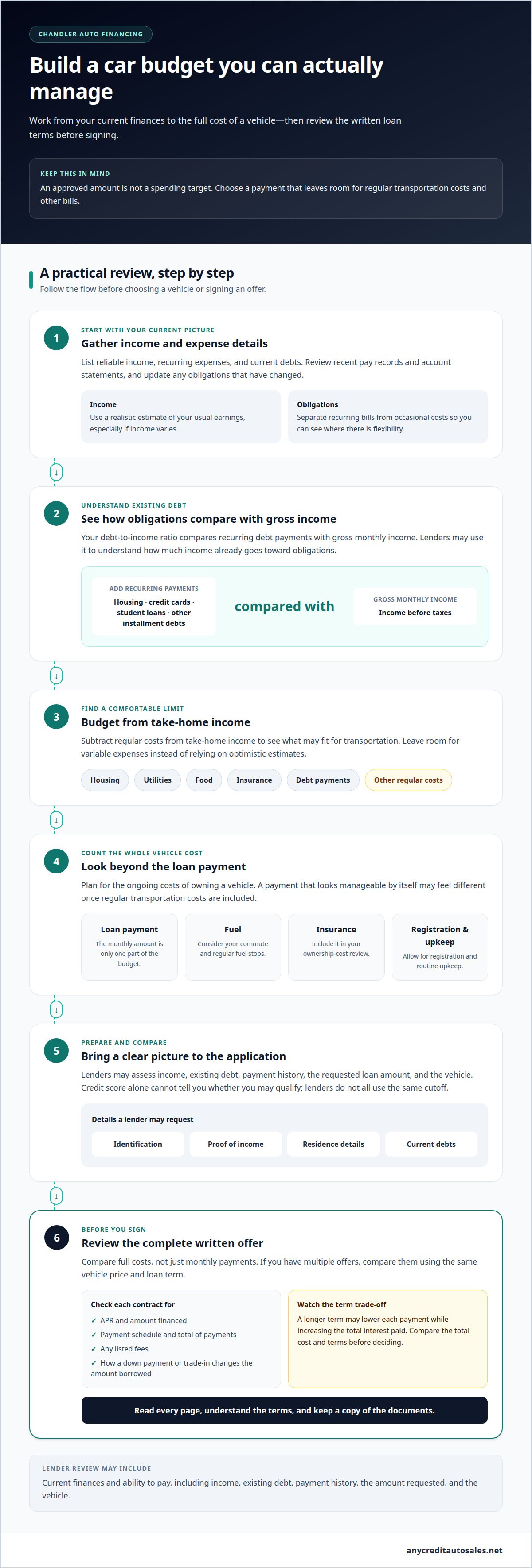
Your debt-to-income ratio compares recurring debt payments with gross monthly income. Lenders may use it to understand how much of your income already goes toward obligations. Add payments such as rent or mortgage, credit cards, student loans, and other installment debts. Compare that total with your gross income before taxes. This gives you a clearer view of how an additional car payment may fit alongside existing commitments.
Set a comfortable limit using your monthly budget, not just the amount a lender might approve. Start with take-home income, then subtract housing, utilities, food, insurance, debt payments, and other regular costs. Leave room for variable expenses, such as fuel or household needs. What remains shows how much transportation may fit without relying on optimistic estimates.
Plan for the full cost of owning a vehicle, not just the loan payment. Include fuel, insurance, registration, and routine upkeep. For example, a payment that looks manageable on its own may feel different once you account for your commute and regular fuel stops. Compare vehicles and loan terms using the same budget assumptions. This makes trade-offs clearer and helps you avoid stretching your monthly spending.
Check your figures before applying. Review recent pay records and account statements, and update any debts you’ve paid off or obligations you’ve taken on. If your income varies, use a realistic estimate based on your usual earnings rather than a high-earning month. List recurring bills separately from occasional costs to see where you have flexibility.
Before accepting an offer, test the proposed payment against your budget. Consider whether it would still work in a month with higher household expenses or lower variable income. If the numbers feel tight, adjust the vehicle price, down payment, or loan amount, then review your budget again. A clear debt-to-income picture helps you discuss an application with confidence and keep the decision grounded in your actual finances.
Used cars, trucks, and SUVs
The right vehicle meets your daily needs without stretching your budget. A used car may suit a Chandler commute and routine errands. A truck may work better if you regularly carry tools or bulky items. An SUV offers a different balance of passenger and cargo space. Start with how you’ll use the vehicle, then compare options within a manageable loan amount.
Look beyond body style. Compare each vehicle’s listed price, mileage, age, condition, and features. These details help you decide whether it suits your needs and the amount you plan to finance. For example, if you rarely carry passengers or large loads, paying for space you seldom use may not fit your priorities. Focus on practical use, not appearance alone.
Before choosing, write down your must-haves and nice-to-haves. A short list can keep your search focused:
- Choose the vehicle type that supports your regular trips and responsibilities.
- Set a maximum amount to finance based on your household budget.
- Compare the condition, mileage, and features of vehicles within that limit.
- Review the written loan terms alongside the vehicle details.
Compare the full financial commitment, not just the monthly payment. The amount financed, APR, and repayment term all affect the loan’s total cost. A lower payment may mean a longer repayment period, so read the terms carefully. Also include fuel, insurance, and routine upkeep when deciding whether a car, truck, or SUV fits your budget.
Bring your shortlist to the dealership and compare vehicles against the same budget. If a truck’s size or an SUV’s extra space adds cost without serving a regular need, consider a simpler option. For a practical next step, explore used vehicles and focus on choices that match your transportation needs and financing budget.
Any Credit Auto Sales LLC: Used Vehicles
Any Credit Auto Sales LLC can help you explore used vehicles and take the next step with an auto financing application. The application connects shoppers with third-party lenders, and the dealership’s credit help can guide you as you consider options suited to your financial situation.
Bring a clear budget and an idea of your preferred vehicle type, such as a car, truck, or SUV. Compare available vehicles with the amount you’re comfortable financing, then review loan terms before deciding. This is a practical next step if you’re ready to explore a vehicle and want guidance on how your credit profile relates to an application.
For a straightforward next step, contact Any Credit Auto Sales LLC to discuss your vehicle and financing needs.
Take Your Next Step With Confidence
Start by deciding what you need from a vehicle and what fits comfortably into your finances. Bring those priorities into your next conversation. A clear budget and a realistic sense of how you’ll use the vehicle can keep the decision grounded in your day-to-day needs.
If you’re exploring auto financing with bad credit in Chandler, Any Credit Auto Sales LLC can help you consider a path forward through its vehicle and financing options. Take the time you need to review the details and choose what feels right for your circumstances.
Contact Any Credit Auto Sales LLC to discuss your next step. A fresh start can begin with a practical choice that works for you.
Frequently Asked Questions
Can Chandler buyers with bad credit get preapproved for an auto loan, and how?
Yes, you can seek preapproval by submitting an auto loan application for a lender to review. First, gather accurate details about your income, housing, and debts, then share them with the dealership handling the application. Any Credit Auto Sales LLC works with third-party lenders, not through in-house financing. Buyers in Chandler, Mesa, Tempe, Phoenix, Queen Creek, and San Tan Valley can use this step to explore financing before choosing a vehicle.
Are there Arizona laws or consumer protections for auto loans and car sales to bad-credit buyers?
Applicable consumer protections depend on the transaction and its documents. Read the sale and loan documents carefully, keep copies, and understand the terms before signing.


