
A low credit score doesn’t automatically shut the door on a car loan. There’s no overall minimum credit score required to get a car loan in the United States. Learning how to finance a car with a low credit score starts with understanding how lenders weigh your credit alongside your income, debts, down payment, and the vehicle’s price.
It’s understandable to worry that a lower score means automatic rejection or a loan that costs too much. Your score can affect the options and interest rate you’re offered, but it’s only one part of the picture.
This guide explains what lenders consider, how to compare loan options, and what to look at beyond the monthly payment. You’ll also learn how steady payments may help build credit over time and when refinancing could be worth considering. With a clearer view of the trade-offs, you can make a choice that fits your budget and plans.
Key Takeaways
- There’s no single minimum credit score for a car loan. Lenders weigh your full financial picture, so a lower score doesn’t automatically end your options.
- Consider how a down payment, co-signer, or co-borrower could affect your application, and understand each person’s responsibility for the loan.
- Compare banks, credit unions, online lenders, and dealership financing by looking beyond the monthly payment to the rate, loan term, and total amount repaid.
- On-time payments can support credit building, and refinancing may be worth exploring if your credit or loan terms improve.
- Any Credit Auto Sales offers used vehicles, an auto financing application, and credit help to support your next steps.
What should I consider with bad credit car loans?
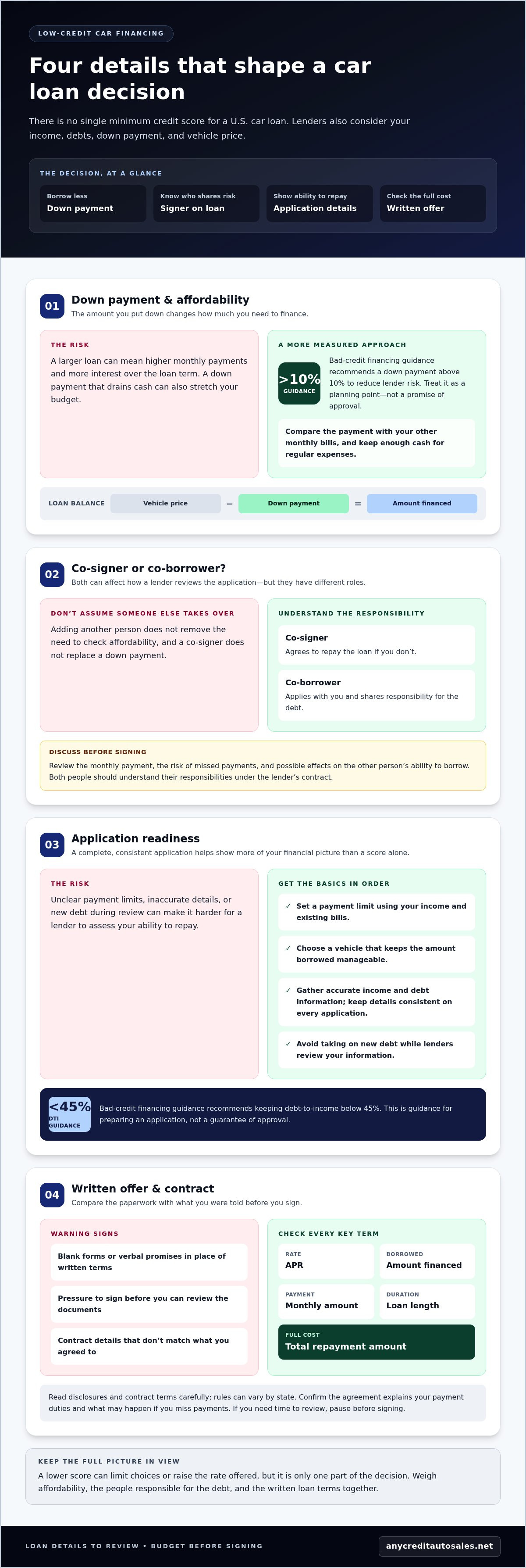
Focus on four parts of the decision: your down payment, the signer on the loan, your approval documents, and the written offer. Together, these details can affect how much you borrow and whether the monthly payment fits your budget.
Down Payments and Loan Affordability
A down payment is money you put toward the vehicle before financing the remaining balance. A larger down payment means a smaller loan, which can lower monthly payments and reduce the interest charged over the loan term.
Bad-credit financing guidance recommends a down payment of more than 10% to reduce lender risk. Treat this as a planning point, not a promise of approval. Keep enough cash for regular expenses instead of putting down an amount that leaves your budget stretched. For example, compare the payment with your other monthly bills before deciding how much to contribute.
Co-Signers and Co-Borrowers
A co-signer agrees to repay the car loan if you don’t, while a co-borrower applies with you and shares responsibility for the debt. Either person’s financial details may affect how the lender reviews the application.
A co-signer doesn’t replace a down payment, and adding one doesn’t remove the need to assess affordability. Before asking someone to sign, discuss the monthly payment, the risk of missed payments, and possible effects on their ability to borrow. Make sure you both understand your responsibilities before signing the lender’s contract.
Approval-Improving Steps
Steps that strengthen an application help a lender assess your ability to repay. A complete application can show more of your financial picture than a credit score alone.
Set a payment limit based on your income and existing bills, then choose a vehicle that keeps the amount borrowed manageable. Gather accurate income and debt information. Bad-credit financing guidance recommends keeping debt-to-income below 45%. Submit consistent details on every application, and avoid taking on new debt while lenders review your information.
Avoiding Scams and Predatory Lending
To avoid a risky offer, compare the written terms with what you were told before signing. Review the annual percentage rate, amount financed, monthly payment, loan length, and total repayment amount. Confirm that the contract includes the terms you agreed to.
Rules can vary by state, so read disclosures and contract terms carefully. The loan agreement should explain your payment duties and what may happen if you miss payments. Don’t sign blank forms or rely on verbal promises. If you’re pressured to sign before you can review the documents, pause and read the full offer first.
What Is the Lowest Credit Score to Buy a Car?
There’s no overall minimum credit score required for a U.S. car loan. A lower score can limit your choices or raise your interest rate, but lenders also weigh income, debts, down payment, and vehicle price.
Credit Score Requirements for Auto Loans
A minimum credit score is a lender’s cutoff for considering an auto loan application. Since U.S. lenders set their own standards, no single score guarantees approval or rules out every option.
Score labels also depend on the model. According to FICO, its Very Poor range is 300-579 points. FICO labels 580-669 Fair, 670-739 Good, 740-799 Very Good, and 800-850 Exceptional. VantageScore uses different bands: 300-499 Very Poor, 500-600 Poor, 601-660 Fair, 661-780 Good, and 781-850 Exceptional.
That distinction matters when applying. A lender may use a FICO Auto Score, a score model designed for auto lending, rather than the score you see in a general credit app. Ask which score model and credit bureau informed an offer, then compare applications using the same model where possible. A score of at least 661 typically gives applicants access to competitive rates and terms, but it isn’t a universal approval threshold.
Scores, Interest Rates, and Loan Terms
Credit scores help lenders estimate repayment risk, and that assessment can shape your annual percentage rate (APR). A higher rate raises borrowing costs. A longer term may lower the monthly payment, but can extend interest charges.
Experian’s third-quarter 2024 data shows the difference across score groups. Borrowers with deep-subprime scores of 300-500 averaged 15.43% APR on new cars and 21.55% on used cars. Prime borrowers at 661-780 averaged 6.70% for new cars and 9.63% for used cars. These are past averages, not personal quotes.
For more current context, lower-score borrowers’ average rates in the first quarter of 2026 ranged from 9.67% to 16.01% for new cars and 14.03% to 21.77% for used cars. Your offer can differ because lenders also consider the vehicle, loan amount, income, debts, and term. Compare APR and total repayment, not just the monthly payment.
Bad-credit loans may carry higher rates and tighter terms because lenders see more risk. Before accepting an offer, check whether the term makes the payment affordable and how much interest it adds overall. If your score falls near a category boundary, review the score model used: a FICO score of 661 is Fair, while a VantageScore of 661 is Good.
Comparing banks, credit unions, online lenders and dealerships
Lenders assess applications in different ways, so compare more than the first approval you receive. Review each offer’s APR, term, fees, and total repayment before choosing.
Lenders and Marketplaces for Bad Credit
Banks, credit unions, online lenders, and dealership-arranged financing are different ways to get an auto loan. Comparing them matters because each may offer different terms and application steps for the same borrower.
A bank may consider your account history, while a credit union may weigh its membership rules and your overall finances. Online lenders let you submit an application remotely. A dealership may send your application to third-party lenders, giving you another way to compare potential offers. Marketplaces can also show options from multiple lenders, but review each actual loan offer rather than relying on a displayed estimate.
Lender Considerations Beyond Credit Scores
Lenders may consider your income, current debts, employment history, down payment, and the vehicle alongside your credit score. These details help show whether the proposed payment fits your finances.
For example, some lenders look for at least 6 months at your current job. A lender may also compare your income with monthly debt payments and assess the amount you want to borrow. Prepare consistent income and debt information for each application. If the car’s price, down payment, or loan amount changes, the offer may change too.
Comparing Offers and Total Costs
To compare offers, review the full written loan terms side by side, not just the monthly payment. This helps you see whether a lower payment comes from a better rate or a longer repayment period.
Use the same vehicle price and down payment when reviewing each lender’s offer. Compare the APR, amount financed, loan term, monthly payment, fees, and total repayment. A longer term can reduce the monthly amount while increasing the time you pay interest. Ask for the complete terms in writing and check that the final contract matches the offer.
Make a simple comparison list for each option: bank, credit union, online lender, or dealership. Record the APR, term, payment, and total amount repaid. Compare offers for the same car and borrowing amount. If one lender quotes a different term, request a matching term before deciding. This makes the cost difference easier to see.
Shopping for a loan can involve more than one application. Submit accurate information each time, and keep notes on which lender requested which documents. Multiple auto-loan inquiries made within a 14-day window count as one inquiry for credit scoring. That window can help you compare offers while keeping your applications focused.
Building credit and refinancing
Building credit takes consistent account management, while refinancing replaces your current auto loan with a new one. Both can affect the cost of keeping your vehicle, but refinancing works best when the new terms improve your overall position.
Start by reviewing your credit report 3 to 6 months before applying for an auto loan. Look for accounts you don’t recognize, incorrect balances, and payment history that doesn’t match your records. This gives you time to understand what lenders may see and address reporting issues before a new application.
Focus on habits that support a stronger credit history. Pay every bill on time, keep credit card balances manageable, and avoid opening accounts you don’t need. A car-loan borrower’s score can improve significantly within a year or two when every payment is on time and the account stays in good standing. Progress depends on maintaining those habits, not just making one payment.
Payment history matters because a late payment can remain in your U.S. credit history for up to seven years. Set a calendar reminder or use automatic payments through your bank or loan account. Keep enough money available before the due date, and contact the lender promptly if a payment problem arises. One missed due date can disrupt the consistency you’re building.
Refinancing may make sense if your credit profile improves or you find a loan with better terms. Compare the new APR, remaining balance, loan length, and total repayment with your current agreement. A lower monthly payment can come from extending the term, which may mean paying interest for longer. Consider the full cost, not just the amount due each month.
Before refinancing, check whether the new loan changes the repayment schedule or adds costs. Confirm how much you still owe and compare that balance with the amount the new lender would finance. If the replacement loan extends repayment well beyond your current timeline, weigh the relief of a smaller monthly payment against the extra time in debt.
Keep the vehicle’s age, condition, and expected ownership period in mind. If you plan to keep the car for years, a better rate may matter more over time. If you expect to replace it soon, compare the remaining balance with the vehicle’s value and avoid focusing only on immediate payment relief.
Make a simple before-and-after comparison. Write down your current APR, monthly payment, remaining term, and total remaining payments. Then put the proposed loan’s figures beside them. This side-by-side view helps you see whether refinancing improves the loan overall or only changes the monthly amount.
Building credit and refinancing are separate choices. Keep paying your current loan on time while you compare possible terms. A steady payment history can support future applications, while careful comparisons can help you avoid replacing a manageable loan with a longer, more costly one.
How do you compare auto loan offers and calculate the total cost?
Compare each written offer using the same vehicle price, down payment, and loan amount. Then calculate the full repayment, because the smallest monthly payment may not mean the lowest total cost.
Start with the amount financed. This is the price and eligible charges covered by the loan, minus your down payment and any trade-in value applied. Check that each lender uses the same starting amount. If an offer uses a different vehicle price or down payment, its payment and total cost won’t be directly comparable.
Next, line up the core terms for every offer:
- APR: The annual percentage rate reflects the yearly borrowing cost, including certain loan charges.
- Loan term: The repayment period determines how many scheduled payments you make.
- Monthly payment: The amount due at each billing date, based on the amount financed, APR, and term.
- Fees and add-ons: Record charges included in the contract and optional products added to the amount financed.
- Total repayment: The sum of scheduled payments, plus any required upfront charges not included in those payments.
To estimate scheduled repayment, multiply the monthly payment by the number of payments in the contract. Add upfront charges that aren’t included in those payments. This gives you a clearer total than focusing on the payment alone. Use the lender’s written figures, since rounding and loan details can affect the exact amount.
Look closely at the loan length. A longer term can make each monthly payment smaller, but payments continue for more months. Compare the total repayment on both offers, not just the monthly difference. If one offer has a lower payment because it lasts longer, decide whether that trade-off fits your budget and vehicle plans.
Check that the contract matches the offer before signing. Confirm the APR, amount financed, payment schedule, term, fees, and any optional add-ons. Ask for an explanation of unfamiliar charges, and make sure optional products aren’t treated as required. Keep a copy of the final agreement and your comparison notes.
Use a simple worksheet with one column per offer. Enter the APR, amount financed, term, monthly payment, fees, and total repayment. Compare the same items across every column, then choose based on affordability and full cost. To put your comparison into practice, start an auto financing application and review the loan terms alongside the vehicle you’re considering.
Any Credit Auto Sales: Used Vehicles
Any Credit Auto Sales LLC helps you explore used vehicles, complete an auto financing application, and get credit help as you consider your next steps. The application connects with third-party lenders, so you can review potential loan options alongside the vehicle you’re considering.
If you’re still weighing affordability, bring your questions about the application and credit factors that may shape your options. Use what you’ve learned about APR, monthly payments, and total repayment to compare the terms presented and decide what fits your budget. Take time to review the details before choosing.
Visit Any Credit Auto Sales LLC online to explore used vehicles and take the next step with an auto financing application.
Take Your Next Car-Buying Step With Confidence
Learning how to finance a car with a low credit score can help you approach your next decision with more control. Consider how you’ll use a vehicle each day and which features matter most. That gives you a practical way to narrow your choices while keeping your budget in view.
Any Credit Auto Sales LLC offers used vehicles, an auto financing application, and credit help. If you’re considering how to finance a car with a low credit score, explore a vehicle and review financing steps that fit your situation. Take the time you need to understand the terms and choose what works for you.
Contact Any Credit Auto Sales LLC to discuss your next step. You deserve to make this decision with care, clarity, and confidence.
Frequently Asked Questions
How to finance a car with a low credit score in Arizona?
To seek a car loan in Arizona, organize your income, debt, and vehicle details, then compare written offers from lenders available to you. Review the APR, loan length, and total repayment before accepting. Any Credit Auto Sales LLC serves shoppers in Chandler, Mesa, Tempe, Phoenix, Queen Creek, and San Tan, Arizona, with used vehicles, an auto financing application through third-party lenders, and credit help.
What Is a FICO Auto Score?
A FICO Auto Score is a FICO scoring model designed for auto lending. It may differ from the general-purpose score shown in a credit app because it uses a model tailored to vehicle loans. If an application decision surprises you, ask which score model was used and review the credit report behind it. That can help you spot information that needs attention before another application.
What credit score is considered poor for an auto loan?
“Poor” depends on the scoring model. FICO labels scores from 300-579 points Very Poor, while VantageScore labels 500-600 points Poor. The same number can therefore carry different labels across models. A lender may also use an auto-specific score, so compare like with like. For example, check whether the score you’re viewing is a FICO Auto Score or a general credit score.
Can you get a car loan with a low credit score?
Yes. There’s no overall minimum credit score required for a U.S. car loan, and lenders set their own approval criteria. A lender may consider your income, existing debts, down payment, and the vehicle alongside your credit history. For example, a lower-cost vehicle can reduce the amount you need to finance. Review the payment and full loan terms to see whether the offer fits your budget.
What interest rates and loan terms do low-credit car buyers qualify for?
Rates and terms depend on the lender, borrower, vehicle, and loan amount. Experian’s third-quarter 2024 data showed average used-car APRs of 21.55% for deep-subprime borrowers with scores of 300-500, and 14.07% for near-prime borrowers with scores of 601-660. These are historical averages, not individual offers. Compare each lender’s APR and total repayment, since a longer term can change the overall cost.
How much down payment helps secure a car loan with bad credit?
Bad-credit financing guidance says a down payment of more than 10% may reduce lender risk. A larger contribution also lowers the amount you borrow, but it shouldn’t leave you short on essential expenses. Consider your savings and recurring bills before choosing an amount. A trade-in may also help reduce the amount financed, depending on its value and any balance still owed on it.
Where can you get a car loan with bad credit: banks, credit unions, online lenders, or dealerships?
You can apply through banks, credit unions, online lenders, or dealership-arranged financing. These options use different application processes and may connect you with different lending partners. Compare the written APR, payment schedule, and total repayment rather than relying on an initial estimate. In Chandler, Mesa, Tempe, Phoenix, Queen Creek, and San Tan, Any Credit Auto Sales LLC offers an auto financing application with third-party lenders.
Should you use a co-signer or trade-in to qualify for a car loan with bad credit?
A co-signer takes responsibility for repaying the loan if you don’t, while a trade-in can reduce the amount you need to borrow. Discuss payment responsibilities and the effect of missed payments with a potential co-signer before applying. For a trade-in, consider its value and any loan balance attached to it. Compare the resulting amount financed with your budget before deciding which option fits.


