
A clean ad and a confident seller don’t prove a car is dependable. If you’re searching for reliable used cars Chandler AZ, the best way to assess a vehicle is to check its condition, records, and driving behavior. That can feel like a lot to judge in one visit, especially when you’re trying not to miss a warning sign.
You don’t need to be a mechanic to make a more informed choice. A checklist can help you spot wear, ask about service and ownership history, and pay attention to how the car feels on the road. In Arizona, heat and dust also make it sensible to check tires, visible rubber parts, and the air-conditioning system.
This guide covers what to inspect before and during a test drive, which records to review, and when to consider an independent pre-purchase inspection. It also explains how to weigh what you find against your driving needs, so you can compare vehicles calmly and decide whether one feels right for you.
Key Takeaways
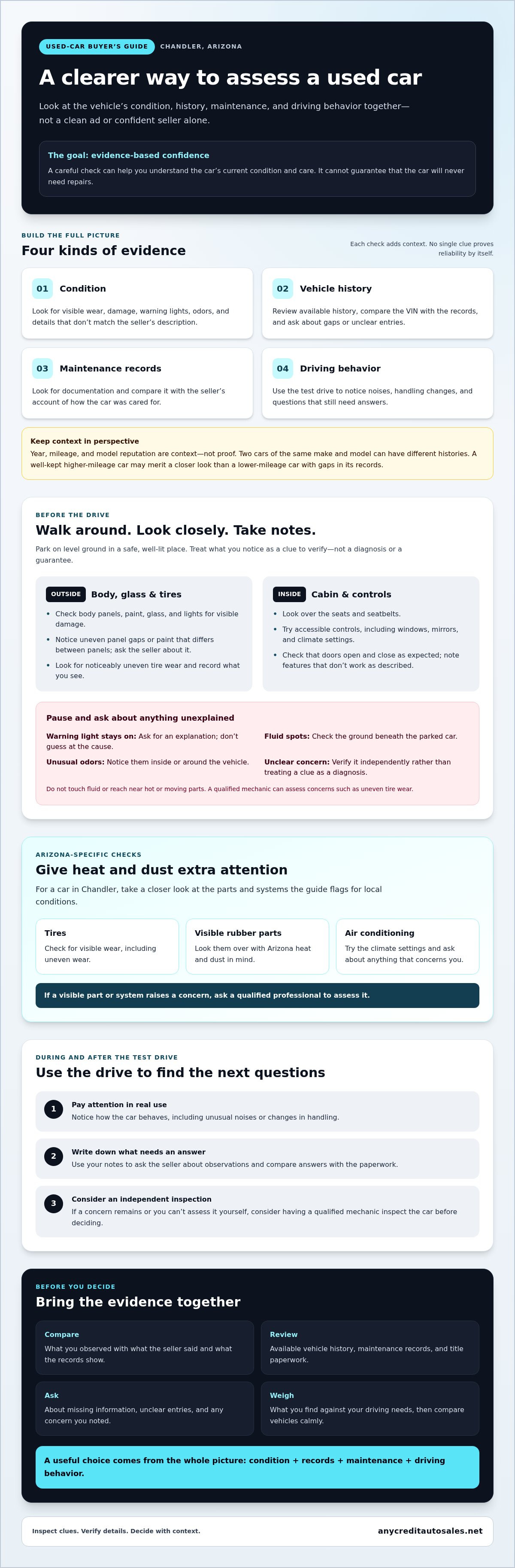
- Assess reliable used cars Chandler AZ by looking at condition, history, maintenance records, and driving behavior together.
- Use a walk-around to note clues such as uneven tire wear, mismatched panel gaps, warning lights, or unusual odors.
- Compare the vehicle identification number (VIN) with its records, then use the test drive to identify questions that still need answers.
- Check tires and visible rubber parts with Arizona heat and dust in mind; ask a qualified professional about concerns.
- Bring your notes to the seller and review available history and title paperwork before deciding.
How to Judge Reliable Used Cars Chandler AZ
A reliable used car isn’t one that comes with a promise it will never need repairs. It’s one you can assess using useful evidence before you decide. When comparing reliable used cars Chandler AZ, focus on the individual vehicle rather than relying on its badge, reputation, or a seller’s description alone.
That evidence matters because two cars of the same make and model can have very different histories. Year and mileage offer context, but they don’t tell the whole story. A car’s past use, maintenance, wear, and any damage can all affect its condition today. A well-kept vehicle with higher mileage may deserve a closer look than a lower-mileage one with gaps in its records. Neither detail proves reliability by itself.
What does reliability mean when buying a used car?
Separate what you can observe now from what you hope will happen later. You can check for visible wear, review available records, and see how a car behaves during a drive. You can’t know with certainty that it won’t develop a problem down the road.
Used-car reliability is evidence-based confidence in a vehicle’s current condition and care, supported by its history, maintenance records, and driving behavior. This keeps the decision grounded and avoids broad assumptions about a model being “good” or “bad.” Use model reputation as background, not as a substitute for checking the specific car.
Which evidence should you gather before deciding?
Think of each check as one part of the picture. A walk-around can reveal visible wear. Vehicle history and maintenance records can add context about the car’s past, though reports may not show every event or repair. A test drive helps you notice how the vehicle responds in real use. An independent inspection can provide another set of eyes on concerns you can’t assess yourself.
- Condition: Note visible damage, wear, warning lights, or anything that doesn’t match the seller’s description.
- Vehicle history: Review available history information and ask about gaps or unclear entries.
- Maintenance records: Look for documentation and compare it with the seller’s account of the car’s care.
- Driving behavior: Pay attention during the test drive and write down noises, handling changes, or unanswered questions.
Compare what you’re told with the paperwork and what you observe. The broader used car market includes different sales channels, but the same habit applies in any of them: verify details instead of assuming. Use the inspection checklist in this guide to work through the car step by step, then compare your notes with the information available for each vehicle.
Inspect a Used Car in Chandler: Exterior, Interior, and Mechanical Clues
A careful walk-around can help you spot questions worth asking before a test drive. Park the car on level ground in a safe, well-lit place, and take your time. When comparing reliable used cars Chandler AZ, treat what you see as clues to verify, not proof of a fault or a clean bill of health.
What should you look for outside and inside the car?
Start outside. Walk around the vehicle and check the body panels, paint, glass, lights, and tires. Look for uneven panel gaps, paint that doesn’t match from one panel to another, or visible damage. These details don’t confirm past damage, but they’re fair questions for the seller. Check for noticeably uneven tire wear, too. A qualified mechanic can assess what it may mean.
Next, sit in the cabin. Look over the seats and seatbelts, then try accessible controls such as the windows, mirrors, and climate settings. Check that doors open and close as expected. Compare your observations with the seller’s description. If a feature described as working doesn’t respond, make a note and ask about it.
Which warning signs deserve a closer look?
Observe the dashboard as the car starts. Ask about any warning light that stays illuminated, and don’t assume you can identify its cause by sight alone. Check the ground beneath the parked car for fluid spots. Notice unusual odors inside or around the vehicle, but don’t touch fluid or reach near hot or moving parts. A visible clue is a reason to ask questions, not a diagnosis.
- Panel gaps or mismatched paint: Ask whether the seller knows why they differ.
- Uneven tire wear: Record what you see and ask a mechanic to assess it.
- Warning lights or unexplained odors: Ask for an explanation and verify concerns independently.
- Controls that don’t work as described: Note the feature and request clarification.
If an answer is unclear or a concern remains, consider an independent inspection by a qualified mechanic before deciding. The FTC consumer advice also explains what to review when buying from a dealer. Keep your notes handy as you compare vehicles, and browse pre-owned vehicles as you consider your options.
Check Used-Car History, Maintenance Records, and Test-Drive Results
After your visual checks, follow a simple sequence: review available records, match the VIN, take a permitted test drive, then follow up on anything that doesn’t add up. This keeps your decision grounded in more than a polished description or a quick impression.
How can you review a used car’s history and service records?
Ask to review available title and maintenance paperwork. Compare the VIN shown on the vehicle with the VIN on its documents and any history report. If the numbers don’t match, pause and ask for an explanation before moving forward.
Vehicle history reports can offer helpful context, but they aren’t complete records of everything that has happened to a car. NMVTIS-based reports and commercial history reports may draw on different information, so check what each report covers. A missing service entry or an unexplained gap is a question to investigate, not automatic proof of a problem. Ask whether receipts or other records can clarify the timeline, and compare them with the seller’s account.
What should you notice during a test drive?
With the seller’s permission, drive in a safe, familiar area. Try ordinary starts, stops, and turns, along with a range of legal speeds suited to the road and conditions. Notice how the car responds. Listen for unfamiliar sounds, feel for changes in handling or braking, and watch for warning lights. You don’t need to diagnose what you notice. Write it down so you can ask clear follow-up questions.
- Before driving: Confirm you have permission and understand any limits on where to go.
- During the drive: Pay attention to sounds, steering, braking, and dashboard warnings.
- Afterward: Compare what you experienced with the records and the seller’s description.
If a concern remains unexplained, ask a qualified mechanic to assess it before deciding. That can help you understand what needs attention without requiring you to judge a mechanical issue on your own.
No single history report or short drive proves a car is trouble-free; use both to guide questions and decide what needs closer review. A record gap, unusual sound, or mismatch in details doesn’t have to settle the decision on its own. Gather the information you can, resolve open questions, and take the time you need to feel comfortable with your next step.
Arizona Heat and Dust: Local Checks for Chandler Used-Car Shoppers
Chandler’s heat and dust are useful reasons to pay attention to certain parts of a used car. They aren’t proof that a specific vehicle has been damaged. Cars can have different histories, storage conditions, and levels of care. Treat local conditions as a prompt to check carefully, not as a verdict about every vehicle.
During your viewing, focus on items you can observe or test safely. Look for cracks or visible wear on accessible rubber parts, check the tires, and try the air conditioning. A visual check won’t tell you how much useful life a component has left. If you notice something concerning, record it and ask a qualified mechanic to assess it before you decide.
Which heat-related checks are useful in Chandler?
Run the air conditioning during the visit and notice whether it cools consistently. Check tires for visible damage or uneven wear, but leave questions about safety and remaining life to a professional. Battery or cooling-system concerns also need more than a quick glance. Treat anything unusual as a question to verify rather than trying to diagnose it yourself.
- Air conditioning: Note whether cooling seems steady while it runs.
- Tires and rubber: Look for visible wear, cracks, or damage without assuming the cause.
- Battery or cooling system: Ask about concerns and seek a mechanic’s assessment if needed.
How can dust and everyday use affect your inspection?
Look at accessible areas of the cabin and engine compartment for heavy dust or debris. Ask how the vehicle was maintained, and review filter or service records if they’re available. Dust alone doesn’t prove neglect, just as a clean cabin doesn’t confirm that every system is in good condition. If what you see raises a specific concern, ask a mechanic to check it.
Keep your observations specific. For example, note that the air conditioning seemed inconsistent or that a visible rubber part appeared cracked. Share those details with the seller and ask whether records address them. You don’t need to settle every question during a short viewing. A careful check helps you decide what needs follow-up.
As you compare options in Chandler, you can browse pre-owned vehicles. Use what you’ve learned to guide your questions, and take time to verify vehicle-specific concerns before making a decision.
Choose Your Next Step with a Chandler Used-Car Dealer
Your inspection notes can make the next conversation easier. Bring them along, along with questions about anything that didn’t match the vehicle’s description or paperwork. You don’t need to make a decision on the spot. The goal is to understand what’s documented, what remains unclear, and whether you’re comfortable taking another step.
What should you ask before choosing a car?
Ask about the specific vehicle, not just the model in general. Find out what history, maintenance records, and inspection information are available for that car. Review the available vehicle and title paperwork, and compare its details with the listing and your notes. If something doesn’t line up, ask the seller to explain it and clarify whether supporting documents are available.
You can also ask whether an independent inspection is possible. If the test drive or walk-around left you with mechanical questions, an independent mechanic can assess them. That’s a practical way to gather more information before deciding. A seller’s answers and available records can help, but they aren’t a substitute for checking the individual vehicle or a guarantee of future condition.
- Which records are available for this vehicle?
- Can you clarify any difference between the listing, paperwork, and what I observed?
- Can I arrange an independent inspection before making a decision?
How can you take a low-pressure next step?
Take a moment to compare your notes with your needs. Think about how you’ll use the car, which concerns have been answered, and what you still want to verify. You can browse options before contacting a dealership, then bring your checklist into the conversation.
Any Credit Auto Sales LLC offers pre-owned cars, trucks, and SUVs in Chandler and can help shoppers with credit questions. If you choose to apply for auto financing, the dealership assists with an application to third-party lenders. It does not offer in-house or buy-here-pay-here financing. Applying is optional, and approval or terms aren’t guaranteed. You can take one step at a time, starting with the vehicle and its available paperwork.
When you’re ready to compare options, browse available pre-owned vehicles. Use the same careful checks as you consider your options, and move forward only when the information and the vehicle feel right for you.
Take Your Checklist Into the Next Step
Confidence comes from checking the specific car, not relying on a promise or a model’s reputation. Review its condition, history, and maintenance records, then use a test drive and, if needed, an independent inspection to follow up on questions. In Chandler, include the tires, visible rubber parts, and air conditioning in your checks.
This approach can help you compare reliable used cars Chandler AZ with a clearer sense of what you know and what still needs an answer. Any Credit Auto Sales LLC serves shoppers in Chandler, Mesa, Tempe, Phoenix, Queen Creek, and San Tan with pre-owned cars, trucks, and SUVs. The dealership also offers credit help, and financing applications connect with third-party lenders. You can take your time, review available vehicle information, and decide what feels right for you.
Ready to explore your options? Browse available pre-owned vehicles and bring your checklist along. You’ll be better prepared to ask thoughtful questions and take the next step at your own pace.
Frequently Asked Questions
How can I tell if a used car is reliable before buying it?
Look for consistent evidence across the car’s condition, history, maintenance records, and driving behavior. Check that the seller’s description matches the paperwork and what you observe. A clean appearance or a strong reputation for a particular model isn’t enough by itself. For reliable used cars Chandler AZ, assess the specific vehicle’s year, mileage, use, and care, and follow up on unexplained gaps or concerns before deciding.
What should I check when inspecting a used car in Chandler, AZ?
Start with the exterior, then check the cabin and accessible areas while the car is parked safely. Look for uneven panel gaps, mismatched paint, glass or light damage, and uneven tire wear. Inside, try basic controls and check the seats and seatbelts. Notice warning lights and unusual odors. These are clues to ask about, not diagnoses. Write down what you find and compare it with the seller’s description.
Should I get an independent inspection before buying a used car?
An independent inspection can be a helpful next step if you want a qualified mechanic to assess the car beyond what you can check during a viewing. It’s especially worth considering when you notice an unexplained warning light, unusual sound, visible wear, or a gap in the available records. Ask the seller whether an inspection can be arranged. Use the findings to clarify questions before making your decision, not as a guarantee about future repairs.
Can a vehicle history report show every accident or repair?
No. A vehicle history report can provide useful information, but it may not include every accident, repair, or service visit. Different reports may draw on different sources, so check what the report covers and compare it with available maintenance records and title paperwork. Match the vehicle identification number on the car to the documents. If dates or details don’t line up, ask the seller for clarification and look for supporting records.
What should I check on a used car because of Arizona heat?
Check that the air conditioning cools consistently during your visit, and look over the tires and visible rubber parts for cracks or wear. Heat is a reason to pay attention to these areas, not proof that a car has damage. A visual check can’t establish a component’s safety or remaining life. If you notice a concern, note it and ask a qualified mechanic to assess it before you decide.
Is a test drive enough to know whether a used car is reliable?
No. A test drive gives you a chance to notice how the car responds, but a short drive can’t establish its full condition or history. With permission, try ordinary starts, stops, turns, and safe, legal speeds. Listen for unusual sounds, feel for changes in handling or braking, and watch for warning lights. Record concerns, then compare them with the available records and seek a mechanic’s advice if questions remain.
What documents should I review before buying a used car in Arizona?
Ask to review the available title paperwork, maintenance records, vehicle history report, and purchase documents for that specific car. Compare the VIN on the vehicle with the number on each relevant record. Check that details such as mileage and vehicle identification match, and ask about gaps or inconsistencies rather than assuming they prove a problem. Shoppers in Chandler, Mesa, Tempe, Phoenix, Queen Creek, and San Tan can use the same careful document review before deciding.


